
It can be confusing distinguishing between the different types of turkey, here is a helpful guide.
With Thanksgiving so close at hand, many of us will soon have to find the perfect turkey for the big meal. This can be tricky with so many different choices that sound so similar. For example, Organic and Natural sound like they mean the same thing, and normally they kind of do, but the U.S.D.A. regulates them differently. Here is a handy little guide to help you get the right turkey for you and your family.
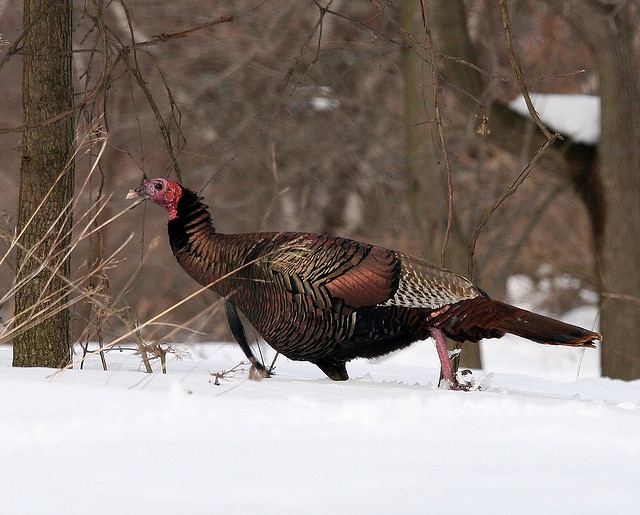
A turkey trotting through the snow
Free-range: These turkeys get to run around outside. In fact, to be classified as free-range the U.S.D.A. has to certify that the turkeys had access to the outdoors. They generally eat grains or grasses they find in their pens, but there is no required diet to get a free-range label.
Organic: Turkeys that get an organic label must be raised free-range, they must be antibiotic free, and they must be fed an organic vegetarian diet. This means the grains and grasses they eat are not allowed to have been treated or grown with pesticides. These turkeys are the ones that would be doing yoga, if turkeys did that sort of thing.
Natural: There are no requirements for labeling a turkey as ‘natural’. It is a marketing buzz word that people associate with a healthy diet, but when it comes to turkey labeling it does not actually mean anything. These turkeys are not necessarily bad, but you will have to do a little more research to find out exactly where the turkey came from and how it was raised.
Kosher: Kosher turkeys are raised and slaughtered according to Jewish customs. They have to be fed a vegetarian diet, be slaughtered in a certain way, and undergo a salting process after slaughter. Because these turkeys have already been salted, make sure you don’t brine them.
Heritage: Before the 1920s many different types of turkeys were popular and easy to find. Then, Broad Breasted White turkeys took over because they are easily farmable, larger, and contain more white meat. Heritage turkeys are any of the breeds that lost their popularity. They generally have much more dark meat and are smaller. They are also said to have a much stronger turkey flavor.
Wild Turkey: In the U.S.A. it is illegal to sell wild turkeys. To get one you have to either shoot it yourself or have a friend shoot it and gift it to you. You will occasionally see a turkey marked as ‘wild’ in a market, but these are just pasture raised birds, usually of some heritage breed.
Self-Basting: A self-basting bird has been injected with butter, oil, salt, herbs, and spices. They come pre-seasoned to save the cook the trouble of continually basting during cooking. If you are looking for a shortcut, getting a self-basting bird might be where you want to start.
Conventional: This is the mass produced turkey, raised in a cage and fed antibiotics. They are always Broad Breasted White turkeys, which were bred to have more white breast meat and to be larger.
 Dr. Mike Malone and his team practice expert cosmetic dentistry in Lafayette, LA. Dr. Malone is the former president and current accredited member of the American Academy of Cosmetic Dentistry. He is also the official Cosmetic Dentist of the Miss Louisiana USA and Miss Louisiana Teen USA pageants. Check out his website for more information.